Hymn Descants for Trumpet or Flute with Organ
All Recordings © Copyright 2007 by David Summer
A hymn descant is a counter melody usually pitched higher than the melody of the hymn. David makes use of his own flute and trumpet hymn descants as part of his performance work as a trumpeter and flutist for special church services.
Hymn Descants Played During a Service
During the church service, a trumpeter or flutist usually doesn’t play on every verse of a hymn, but rather only on alternate verses. When playing hymns while the congregation is singing, it’s important for an instrumentalist to make sure the members of the congregation remain confident in their singing. Sometimes, people who are not trained vocalists can become distracted when another instrument is playing along with a keyboard. With this in mind, it’s usually best to play the melody on the first verse, particularly when playing the trumpet with a hymn tune.
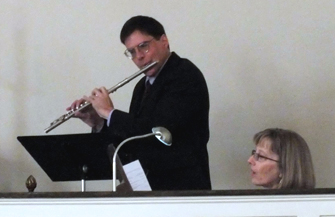 While playing this first verse in performance, David will listen carefully to the congregation to make sure he is not overshadowing them and also to see how confident they are with the melody. If it seems the congregation knows the hymn very well, then a descant can be introduced in a later verse. In any case, hymn descants are usually reserved for later, or even only final verses.
Often David will perform a hymn on the trumpet or flute while the choir is singing without the congregation. In this case, if the choir is very experienced, a descant can be introduced right away.
Occasionally, David will compose a descant especially for a particular performance. For an Advent service at St. Anne’s in-the-Fields Episcopal Church in Lincoln, MA, David composed and performed a flute descant for the Advent carol Come, Thou Redeemer of the Earth.
Listen to more of David’s live location performances recorded at several churches throughout Massachusetts.
Performing a Hymn as an Instrumental Postlude
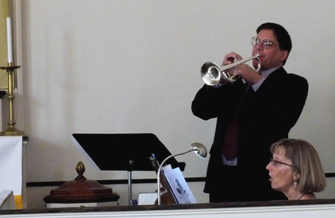 A lively hymn featuring a descant played on the trumpet with organ accompaniment makes for a crowd-pleasing church service postlude. Members of the congregation enjoy hearing a hymn they familiar with, and may have sung, played in a different way, as an instrumental version.
David has written several trumpet descants for well-known hymns. When playing for a church service, he often makes use of these for an instrumental postlude. The usual form for these trumpet postludes is to play the hymn melody once through and then to play the descant. The organist simply plays his or her usual part twice through.
I Sing the Mighty Power of God (Ellacombe) by Isaac Watts is an excellent postlude hymn. In this recording, David plays the melody and then his self-composed trumpet hymn descant. This recording of I Sing the Mighty Power of God was made by David Summer not at a church location, but rather using his home recording studio. David sequenced and recorded the organ/keyboard part and then recorded his trumpet on another track.
Help With Hymn Descants, Instrumental Lessons
 See more information about taking quality private trumpet lessons from David Summer.
  Playing the trumpet and flute in a church setting is a very specialized type of performance playing. It’s not for every trumpeter or flutist. However, it can be an excellent experience for a student to play at his or her own church, or a friend’s church. If a student expresses interest in playing in church, David uses experience as a performing musician to help make this a great fun and learning experience for his students.
In preparing a student to play in church, David will go over hymns with an eye toward interpretation and presentation, especially in regard to playing the trumpet at an appropriate volume. Students might also need help in transposing hymn tunes either for Bb trumpet or as compensation for key changes being made by the church music director to suit the needs of the choir.
 See more information about taking quality private flute lessons from David Summer.
 If you’re a trumpeter or flutist who plays in church, or are interested in doing so, you should consider writing your own hymn tune descants. By writing the descants yourself, you can take advantage of your own particular playing style. If you need help, your private lesson trumpet teacher or flute teacher should be able to assist you.